The Holodomor and Jerry Berman’s Letters
Essay in Both Sides Face East: Vol. 2 (eds. Julia Sushytska, Alisa Slaughter and ariel rosé), Academic Studies Press, forthcoming.
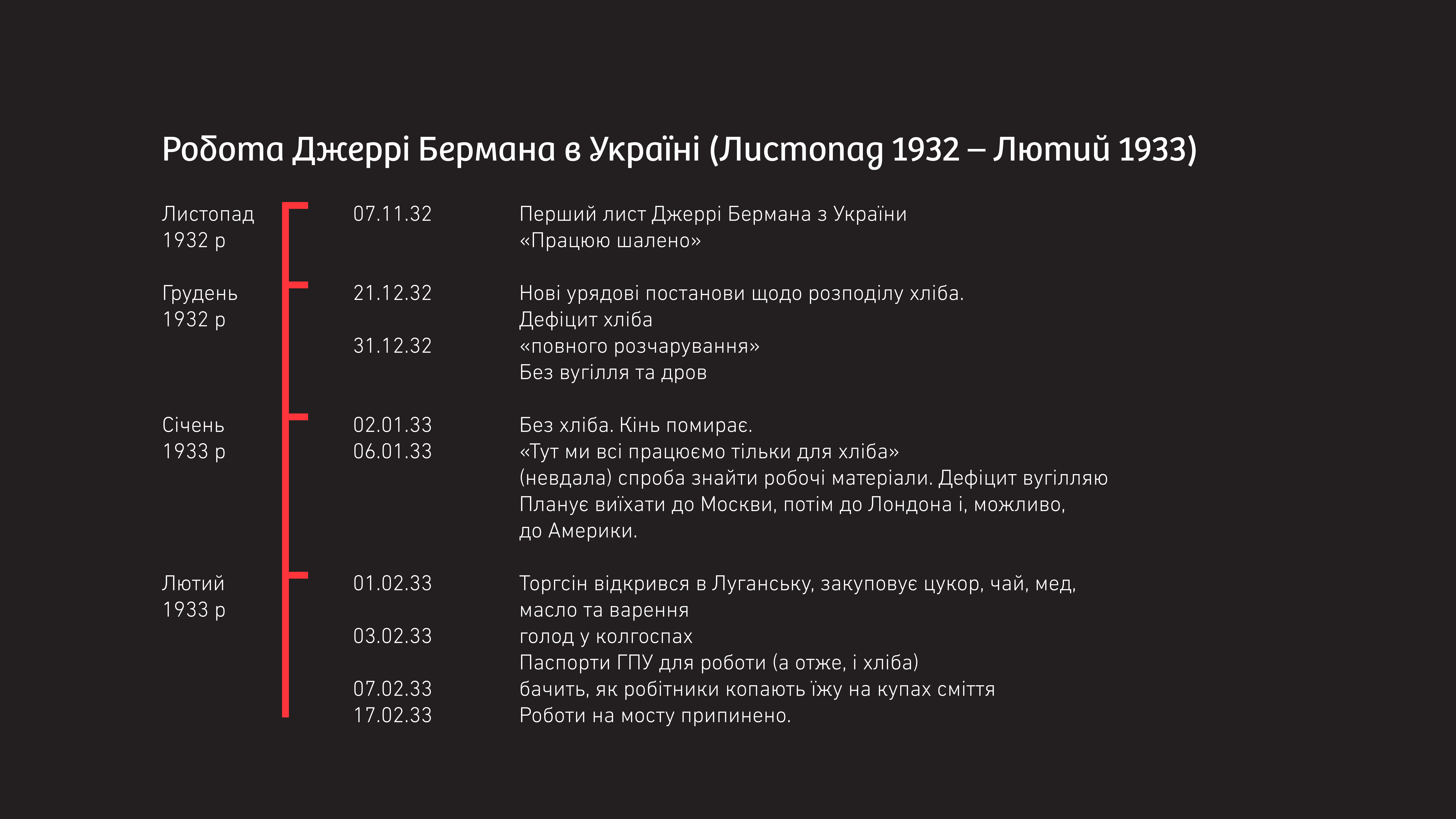
A timeline of Jerry Berman’s work in Ukraine Nov 1932–Feb 1933.
ABSTRACT
This essay explores artistic responses to Ukrainian histories using Lawrence L. Langer’s theories of the literary imagination as a starting point. The claim of art’s importance to bridge literal truth with imaginative reality is central to Langer’s arguments on the role of creative work following atrocity. Exploring debates on memory politics and the visual arts I focus on witness testimony from the Holodomor, the Great Famine in Ukraine, 1932–33, letters from South African engineer, Jerry Berman. This collection spans Ukraine, South Africa, London and New York, providing objective and subjective accounts of the period. Results of the project are a digital archive. I am exploring the role of the artist, as Langer describes, responsible for finding style and form to represent the atmosphere of the work. [1]
1. Lawrence L. Langer, The Holocaust and the Literary Imagination (New Haven: Yale University Press, 1975), 1–30.